Manila is the capital of the Philippines. It is one of the sixteen cities forming Metro Manila. Manila is located on the eastern shores of Manila Bay and is bordered by Navotas and Caloocan to the north. Quezon City to the northeast, San Juan and Mandaluyong to the east, Makati on the southeast, and Pasay to the south.
 Manila has a total population of more than 1,660,714 according to the 2007 census. Manila City is the second most populous city in the Philippines, behind its neighbor, Quezon City.

Manila began as a settlement on the banks of the Pasig River, and its name originates from "Maynilad," referring to the mangrove plant known as Nilad, which was abundant in the area. The earliest written account of the city is the 10th century Laguna Copperplate Inscription which describe an Indianized kingdom maintaining diplomatic relations with the Kingdom of Medang and commercial exchanges with Ancient Japan and Song Dynasty China. The city was invaded by Brunei's Sultan Bolkiah and was already Islamized by the 15th Century.
Manila eventually became the center of Spanish activity in the Far East and one end of the Manila-Acapulco galleo trade route linking Latin America and Asia. This caused it to be called the "Pearl of the Orient". For over 3 centuries Manila was colonized and administered by Spain which left a great architectural heritage throughout the Philippines, especially with respect to churches, forts and other colonial buildings which can still be seen in the ruins of Intramuros, built in the late 16th century. Several Chinese insurrections, local revolts, a British Occupation and a Sepoy mutiny also occurred thereafter. Later, it saw the rise of the Philippine Revolution which was followed by the arrival of the Americans who made contributions to the city's urban planning and development only to have most of those improvements lost in the devastation of World War II. Since then the city has been rebuilt.
Climate
Under the Koppen climate classification system , Manila features a tropical savanna climate that borders on a tropical monsoon climate. Together with the rest of the Philippines, Manila lies entirely within the topics. Its proximity to the equator means that the temperature range is very small, rarely going lower than 20 degrees Celcius and going higher than 38C. However, humidity levels are usually very high which makes it feel much warmer. It has a distinct, albeit relatively short dry season from January through April, and a relatively lengthy wet season from May through December.

By train- Manila is crossed by three lines of the Strong Republic Transit System (SRTS), Metro Manila's (partially) integrated railway network: the Yellow and Purple lines, operated by the Light Rail Transit Authority, as well as the Orange Line, operated by the Philippine National Railways. Metro Manila's main passenger train station is Tutuban in Tondo. The PNR operates the Bicol Express daily night train between Manila and Naga in Camarines Sur, as well as nighttime commuter service to Binan in Laguna, which returns to Manila in the early morning.
By bus- Several bus routes to points in Metro Manila and surrounding provinces either pass through or converge in Manila. The city has several bus terminals, with the biggest being the Park and Ride Lawton bus terminal along Padre Burgos St., beside the Manila Metropolitan Theater. Provincial bus companies also operate their own terminals which are dispersed throughout the city.
By boat- Manila is the hub of the Philippine ferry network, and ferries to most major cities will stop at the Manila South Harbor, the city's main passenger seaport. Several companies operate ferries to Manila from points throughout the Philippines, and cruise ships occasionally stop in Manila throughout the year.
Getting Around - Manila is crossed by three lines of the Strong Republic Transit System (SRTS). Several city and provincial bus routes either cross through or terminate in Manila. Manila is also served by several jeepneys and taxis.
Landmarks

*Chinatown - Manila has one of the largest China towns in the world, where one can find exotic Chinese goods and delicious cuisine.
*Intramuros - At the northern end of the Bay lies the remnants of the old walled Spanish settlement of Manila, Intramuros (Spanish for 'within the walls'). Intramuros contains some of the city's most interesting museums, ruins, and churches including the Manila Cathedral, the most important church in the country.
*Manila Hotel - Just outside Intramuros and on the edge of Manila Bay is the beautiful and historic Manila Hotel, a legacy of the American colonial era and the place where General Douglas MacArthur made his home before World War II.
*University of Santo Tomas (UST) - The University is oldest and first University in the whole of Asia and the Philippines. It was used as a camp by the Japanese during their occupation where they imprisoned about 10,000 people even though it only can hold 4,000.
*Manila Metropolitan Theater- is an art deco building designed by Filipino Architect Juan M. de Guzman Arellano and inaugurated on December 10, 1931, with a capacity of 1670.
Festival
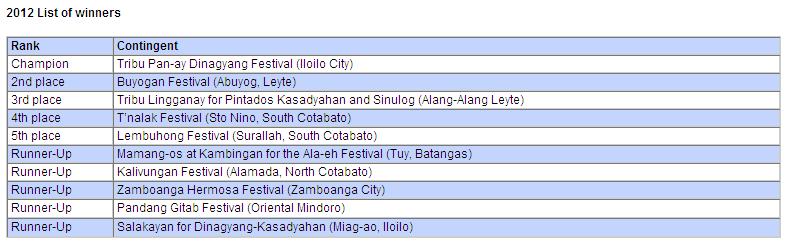
Aliwan Festival also called as "The Mother of All Fiestas" is an event that will feature the famous cultural festival that can be found in the Philippines. Aliwan is a Tagalog word for "entertainment" or "amusement". This is held during the summer month of the year which is either in April or in May, at Star City Complex in Pasay City. This is a battle between the best Philippine festivals as the participants dance in a parade with float competitions as well. This is considered as one of the biggest and loudest festivals in Manila as this touches the different sides of the festival in the Philippines combined.
Some information, images, and videos being used on PhilsTravelGuide.blogspot.com are readily available in different website links on the world wide web and believed to be in public domain. As such, contents used in our articles are believed to be posted within our rights according to the U.S. Copyright Fair Use Act (title 17, U.S. Code).
All images, videos, and information used in this site are copyright of their respective owners.
PhilsTravelGuide claims no credit for them unless otherwise noted. If you believe that any content appearing on PhilsTravelGuide infringes on your copyright and do not wish them to appear on the site, please contact us and the infringing material will be removed immediately. Thank you.